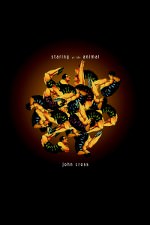
staring at the animal
by John Cross
$10.95
“In [s]taring at the [a]nimal, the enchanting process of mind runs together forces and time, leaving the reader wondering whether the ‘good sun’ of the book’s first poem stands for disciplined sight or for a unifying glow over which sight can play…”—Jay Thompson, The Kenyon Review
Format: paperback
“In [s]taring at the [a]nimal, the enchanting process of mind runs together forces and time, leaving the reader wondering whether the ‘good sun’ of the book’s first poem stands for disciplined sight or for a unifying glow over which sight can play…” —Jay Thompson, The Kenyon Review
Review of staring at the animal from the Chapbook Roundup in Issue 21 of Ghoti Magazine:
This is an attractive looking chapbook from Tupelo Press, winner of the Snowbound Series.
“I’d like for someone //…to explain to me /…why I hear…emptying out // I hear breathing,” Cross says in “The Quiet Store,” a mournful poem of delicate, broken feelings. Cross offers compelling images, but more than that, his poems are to be felt. In “After Marie’s First Mechanical Bird” describes a landscape full of broken birds, “the disassembling glitters,” he says. The line is apt and applies to the collection as a whole—these are disassembled poems, imagistic, broken things that ache in their jaggedness, but the disassembling does, indeed, glitter.
In “Heat,” Cross uses anaphora to show the many faces of “a good sun” which adds a kind of not just warmth but loving-warmth to the world; “a good sun gathers leaves at night / murmurs blankets of snow / faint light cusping the ghostweed.” “The Buzz Between Nearly Equal Wavelengths” gives us the title in a kind of love poem: “spring & you’re perfect/ light & everything/ sex (but nothing’s new: / radio static / too many ghosts) / & I remain / staring / at the animal.” Cross seems to disdain the animal—he searches for something higher. Throughout the collection, Cross searches for something higher than base reality and experience. In “The Off-Scourings of the Hog” he continues this theme: “If I succumb to hunger,” the poem begins, though the hunger seems to be more ephemeral than stomach pains. “To knock at your house of uncertain aspirins / …And all these brittle slivers… / And these awkward hard-ons.” Here, Cross plants the poem firmly in experiential imagery. But he’s still fighting this settling-in. In the final line, he states: “To convince my wracked windows it isn’t time / By screaming out of them It is not time.”
Winner of the sixth annual Snowbound Chapbook Series Award
“John Cross’s poems are like prickly, finely wrought, shattered gems cast of awe and ruin. They are full of the guilt and pain and the ferocity of imagination it takes to get through the day. Antigone is at home in this world as much as a carny. staring at the animal is a tonally haunting songbook, a rescued hymnal, a guide for when we might ‘start upright in (our) seats.’”— Gillian Conoley, final judge for the Snowbound Chapbook Award
“Spun from startling, meticulous twists of language, these poems make the spine tingle. Cross has a way of grounding association and insinuation in quick sound links that are both sensuous and cerebral. These short, swift pieces shoot us over the surface of a world we recognize just before he suddenly makes it look brand new.”— Cole Swensen
 John Cross earned an undergraduate degree at the University of California, Los Angeles, and an M.F.A. from the Iowa Writers’ Workshop. His work has appeared in New American Writing, Volt, Forklift Ohio, and other journals and was awarded the 2001 Mary Roberts Rinehart Award. He lives in Los Angeles, with his wife and four cats, and he teaches at Westridge School in Pasadena.
Additional information
| Weight | .4 lbs |
|---|---|
| Dimensions | 6 × .5 × 9 in |
When the Water in the Skin was Gone
Looking for an unmutilated place—
At every periphery lies
Something terribly roadside
: God’s footprint—
A hole Big enough for a child-house.
: A quiet that will never
Be silenced—
From an arid language
Driven toward fire
The Carny Phones from Paradise
Our signals would have been of little use
through the peepholes, we agreed. private amusements
reduced to “be very careful.” first kiss
in the trauma of the furniture covered with white
sheets, the door left open for air, “hiss.” a block
away, a carnival: tilt-a-whirl, blue streak, devil’s teacup…
“the mattress held all of us cousins over the ash & rust”
what music of summer bounces under
this pumice of stars. “slippage,” blowing in our ears
at the top of the world ; to the front & rear, lacuna.
we hovered, held fast. dark birds tore past:
the moon returning its borrowed light.
Letter from Kabul
dear friend, I have to do with death.
mostly I write from here:
star bright
fever we call daisy cutter,
fifteen thousand pounds of pure sound
caught up in the meter,
sings toward the feverish blades,
and grass eyes blink out
all over. good night to whomever.
ignite.