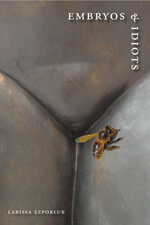
Embryos & Idiots
by Larissa Szporluk
$19.95
_The richness of language in this collection cannot be overstated-Szporluk loves to rake words, to break rocks, to turn the earth in each poem by breaking up the musty and the comfortable. In doing this she brings us new worlds, neat and prettily shaped on the page, but also smart, allusive and self referential.” –Cate Whetzel
Format: paperback
The summer ’08 edition of the Indiana Review contains an excellent review of Larissa Szporluk’s Embryos & Idiots. Part of Cate Whetzel’s review reads thus:
The richness of language in this collection cannot be overstated-Szporluk loves to rake words, to break rocks, to turn the earth in each poem by breaking up the musty and the comfortable. In doing this she brings us new worlds, neat and prettily shaped on the page, but also smart, allusive and self referential.
Larissa Szporluk’s Embryos and Idiots has been reviewed in Publishers Weekly. In it, the reviewer writes:
The story of Anoton [which begins the book] vanishes near the end, and the book becomes simply a collection of (striking) lyrics; until then, his legend, such as it is, provides a thread to connect, and an excuse to elaborate on, Szporluk’s supremely quotable conceits, her images and aphorisms about creation myths and procreation, babies and language, planets and bodies and love, in which “The newborn’s a reborn; every// beloved is the same.”
“In a world at war over fossilized myths, nothing is more urgent than that our myths be rewritten. Larissa Szporluk’s Embryos and Idiots revitalizes the myth of the fall, fulfilling the lineage of Genesis and Paradise Lost. Her Anoton continues the contemporary lyric legacy of Ted Hughes’s Crow, her gardens of Od that of Louise Glück’s The Wild Iris. More personal than poems that proclaim themselves so, Szporluk’s mythic lyrics also make themselves more public than most poems manage, calling down “Shame on the zealous / and jealous. Shame on the half-fish god / who dined on himself and survived.” —H. L. Hix
 Larissa Szporluk was raised in Ann Arbor, Michigan and received her BA from the University of Michigan. She studied at the Iowa Writers’ Workshop and received an MA in Literature at the University of California Berkeley, and an MFA from the University of Virginia where she was a Henry Hoyns fellow. She began her full-time teaching career at Bowling Green State University in 2000 and has since become an associate professor of Creative Writing and Literature. In 2005, she was a visiting professor at Cornell University.
She is the author of four previous books of poetry: Embryos & Idiots (Tupelo, 2007), Dark Sky Question, winner of the Barnard Poetry Prize (Beacon Pres 1998), Isolato, winner of the Iowa Poetry Prize (Univ of Iowa, 2000), and The Wind, Master Cherry, The Wind (Alice James Books, 2003). Her work is included in Best American Poetry 1991 and 2001, New American Voices, and numerous other anthologies. In 2003, she received a National Endowment for the Arts grant to work on Embryos and Idiots.
Additional information
| Weight | .4 lbs |
|---|---|
| Dimensions | 6 × .5 × 9 in |
Democratic Ghosts
It was sad to be between four walls.
The wind brought odors of moss, chanterelles,
cantos of owls. Where is my therapy?
The hands that reached for him were branches,
extensions of his fickle parents.
Death was horrible because death was possible.
Arms tore the shingles from his only roof,
pounded his turtle. My gazelle, my little birdie
of the forest. Lalala. They loved him.
The truth is indestructible. They loved him.
They entered his hut, provided the guests,
the crumb-cakes, then slept in a row, all together,
like a tin of sardines, teenage hookers, brains
off-kilter, and they were warmer there
than anywhere they knew of in his nightmare.
Reaper
His father stepped out in full obsidian splendor
and swung. “Papa!” The head flew off
like a petrified stork, up through the roofless
house and out of the belt of metallic cloud
that kept the stone race bound, and flew
like liberation through the cold infinitude
that expands inside the living like a cache
of eggs. Does it matter what we are made of?
A grain unfolds, the sun, the same, making
gold of morning. The facts then change: gold
is bad, the sun is pain, the malt, black rot,
and all that faith gets cut from our first story.
Idol
Her organs were the resins of ancient pines,
rich with seeds and loess, fatal powders
of a lunatic faust, now-deceased meadows.
Anoton spilled the secret—wouldn’t we all
to get what we want? He told the king
of her whewellite eyes, siliceous oozes,
horn-mad noises in her pelvic forest.
The king had her crushed, the loot handed
over in a moonstone box. But no matter how
hard he shook it, the bee was a silent guest,
a pressure point, a foil, a yellow sponge
that shriveled up in spite of what supplied it.